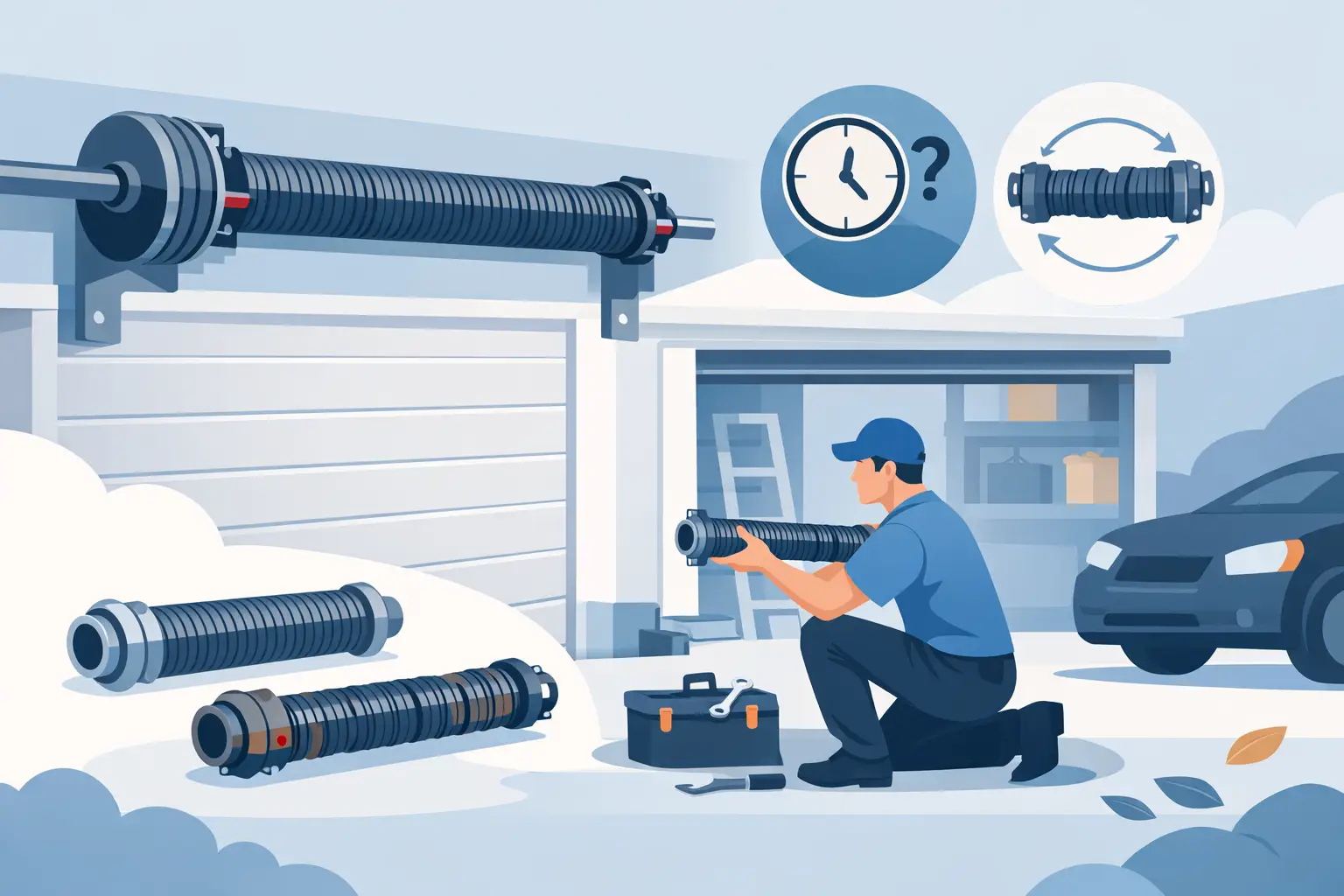
A garage door usually gives you some warning before a spring fails completely. If you are asking when should garage door springs be replaced, the short answer is this: replace them when they show wear, lose lifting power, or break - not after the door becomes unsafe or stuck halfway open.
For most property owners, spring problems start as an inconvenience and turn into a safety issue fast. The door gets heavier, it opens unevenly, or the opener sounds like it is working too hard. In a home, that can trap your vehicle inside. In a commercial setting, it can interrupt deliveries, employee access, or daily operations.
When should garage door springs be replaced?
Garage door springs should be replaced when they break, when they are clearly worn, or when the door no longer opens and closes with proper balance. They should also be replaced if they are near the end of their cycle life and already showing signs of strain.
Most standard springs are rated for a set number of open-and-close cycles. In real-world terms, that often means around 7 to 10 years for an average household, sometimes less for busy homes and more for lighter use. Commercial doors or homes that use the garage as the main entry point can wear springs out much sooner.
Age alone is not the only factor. A five-year-old spring on a heavily used door may be more worn than a ten-year-old spring on a lightly used one. Weather, lack of maintenance, rust, and improper spring sizing can all shorten lifespan.
The most common signs your springs need replacement
The clearest sign is a door that suddenly will not lift. If you hear a loud bang from the garage and later find the door too heavy to move, a spring may have snapped. Many homeowners describe that sound as something hitting the wall or a board cracking. That is common with a broken torsion spring.
You may also notice the door opening a few inches and stopping, or reversing back down. That can happen because the opener is detecting too much resistance. The opener is not designed to do the spring's job. Springs carry the weight. The opener only guides the movement.
An uneven door is another red flag. If one side rises faster than the other, or the door looks crooked while moving, one spring may be failing or the system may be out of balance. That is not something to ignore. Continued use can put extra strain on cables, rollers, tracks, and the opener itself.
Sometimes the signs are more gradual. The door feels heavier by hand. It slams shut instead of lowering smoothly. It jerks during travel. You may see visible gaps in a torsion spring, stretched extension springs, or rust buildup on the coils. All of those point to wear that can lead to failure.
How long do garage door springs usually last?
Most residential garage door springs are built for roughly 10,000 cycles, though higher-cycle options are available. One cycle is one full opening and closing of the door. If you use your garage door four times a day, every day, that adds up faster than many people expect.
A family that enters through the garage several times a day may run through spring life well before the ten-year mark. A rental property, shop, or small warehouse can wear them out even faster. On the other hand, a detached garage used only for storage may get more years out of the same spring set.
Wyoming weather can also be hard on garage door systems. Cold temperatures can make metal components less forgiving, and rust from moisture exposure can weaken springs over time. If the door is already older or has gone without tune-ups, replacement often makes more sense than trying to squeeze out a little more life.
Replace one spring or both?
If your door has a two-spring system and one spring breaks, replacing both is usually the smarter move. The unbroken spring has likely gone through the same number of cycles and is not far behind.
Keeping one old spring and one new spring can also create an imbalance. That can affect how evenly the door lifts and how hard the opener has to work. Replacing both at the same time usually saves another service call and helps the whole system operate more smoothly.
This is especially true on heavier insulated doors, larger residential doors, and many commercial overhead doors. Matching spring strength matters more than most people realize.
What happens if you wait too long?
Waiting too long can turn a fairly straightforward repair into a bigger one. A worn spring can overwork the opener, fray cables, damage rollers, and throw the door out of alignment. If the door drops hard, it can also damage panels or create a safety risk for anyone nearby.
For homeowners, the immediate problem is often access. Your car may be stuck in the garage when you need to get to work, school, or an appointment. For business owners and property managers, downtime can affect tenant access, shipping schedules, and site security.
There is also the issue of safety. Garage door springs are under high tension. When they fail, the release of force is sudden. Trying to force the door open or keep using the opener after spring failure can make things worse quickly.
Can you test whether the springs are still doing their job?
A basic balance check can reveal a lot, but it needs to be done carefully. With the door closed, disconnect the opener and manually lift the door halfway. If the springs are in good shape and properly adjusted, the door should stay fairly close to that position.
If it drops hard, the springs may be worn or under-tensioned. If it shoots upward, the spring setup may be incorrect. If it feels unusually heavy at any point, that is also a sign the system needs attention.
That said, if the door is already acting erratically, looks crooked, or you suspect a broken spring, do not keep testing it. At that point, a service call is the safer move.
Why spring replacement is not a DIY job
Spring replacement is one of the most dangerous garage door repairs. These components store a lot of tension, and releasing or winding that tension the wrong way can cause serious injury. The risk is not just the spring itself. Cables, brackets, and the door weight all come into play.
There is also a sizing issue. Springs need to match the specific weight and height of the door. If the wrong spring is installed, the door may still move, but it will not move correctly. That leads to premature wear on the opener and hardware.
A trained technician checks more than just the broken part. They verify door balance, inspect cables and rollers, adjust the system, and make sure the opener is not being overstrained. That helps prevent repeat problems.
When to call right away
Some spring issues can wait a day or two. Others should be treated as urgent. Call for service right away if the spring is visibly broken, the door is stuck shut or partially open, the opener is straining without lifting the door, or the door looks uneven in the tracks.
If you manage a commercial property, urgency is even higher when the door affects deliveries, fleet access, or building security. The longer a damaged spring is left alone, the greater the chance of added damage and operational disruption.
In Cheyenne and surrounding areas, fast service matters because a nonworking garage door is not just a nuisance. It can affect your whole day. That is why local companies like Mike's Garage Door LLC keep common spring sizes stocked for same-day repairs when possible.
A practical rule of thumb
If your garage door is more than seven years old, used multiple times a day, and showing even minor lifting issues, it is time to have the springs checked. If one spring has already broken, replace the pair. If the door feels heavy, jerks during movement, or the opener suddenly seems weaker, do not wait for a full failure.
Spring replacement is one of those repairs where timing matters. Catch it early and you usually avoid extra damage, extra cost, and the headache of a door that quits at the worst possible moment.
If your door is sending up warning signs, trust them. A good garage door should lift smoothly, stay balanced, and work without a fight.