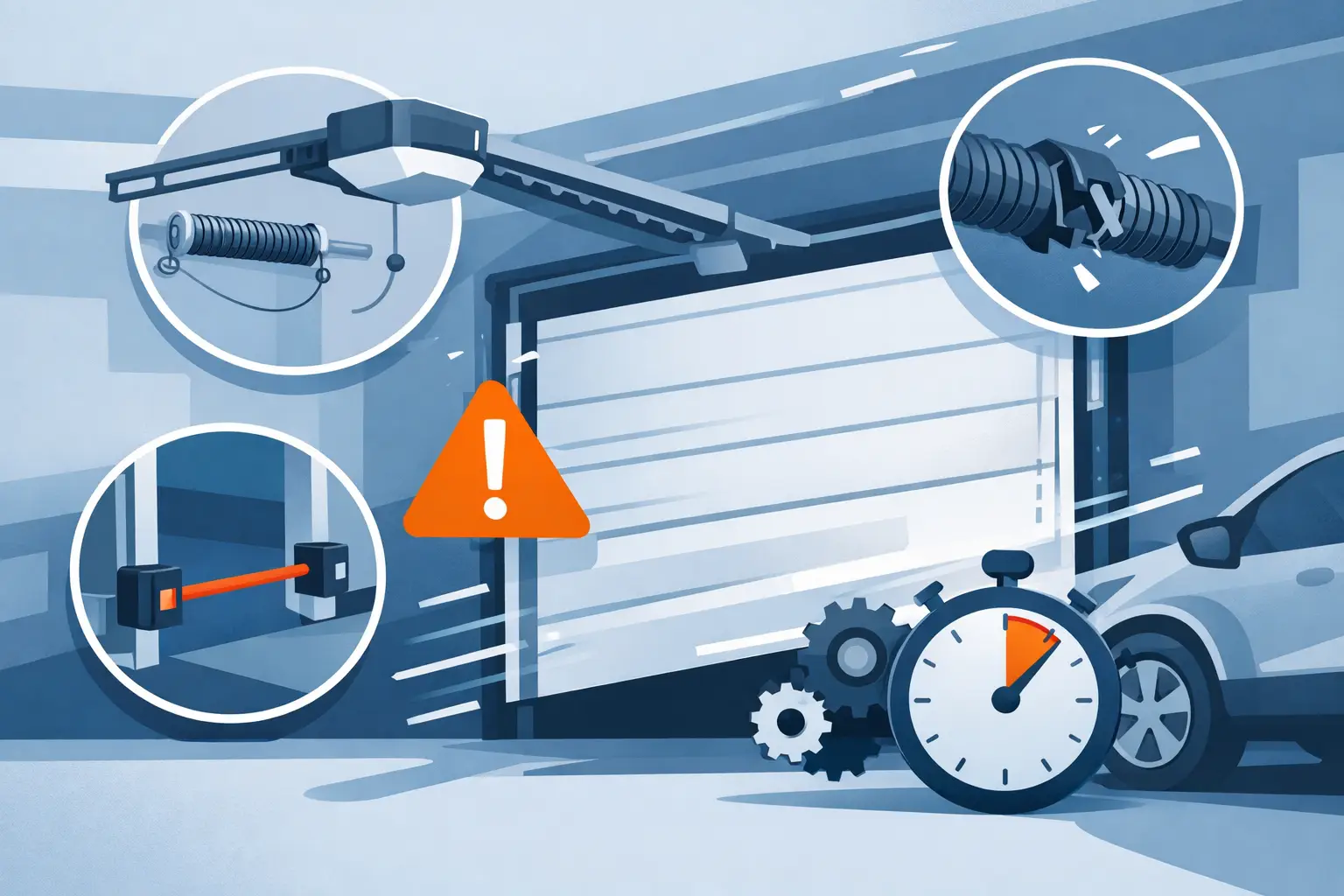
A garage door that drops hard is not just noisy or inconvenient. If your garage door closes too fast, it may no longer be properly supported by its spring system. That creates a real risk of property damage, injury, and a door that becomes stuck halfway through the day. For homeowners, property managers, and business owners in Cheyenne, this is a repair issue worth handling promptly.
What to Do When a Garage Door Closes Too Fast
Stop operating the door until the cause is identified. Keep children, pets, vehicles, and people out from under the opening. Do not try to catch the door as it comes down, even if it appears manageable. A standard garage door can weigh well over 100 pounds, while insulated and commercial overhead doors can weigh substantially more.
If the door is open or partially open, do not pull the emergency release cord. Releasing an already unsupported door can allow it to fall without warning. Leave the area clear and arrange service. If the door is fully closed, leave it closed until a technician can inspect the springs, cables, tracks, and opener.
A door that falls quickly can worsen with every use. What begins as a worn spring or loose cable may turn into a bent track, damaged panels, a broken opener, or a door that cannot be safely secured.
Why a Garage Door Closes Too Fast
The most common cause is a broken garage door spring. Springs carry most of the door's weight so the opener does not have to lift and lower it alone. When a torsion spring breaks, the opener may still move the door for a short time, but it is now handling far more weight than it was designed for. The door may drop rapidly when closing or feel extremely heavy if someone tries to lift it manually.
You may hear a loud bang from the garage when a torsion spring breaks. That sound is often the spring releasing its stored tension. A visual check may show a noticeable gap in the coil above the door, but do not touch it. Springs are under high tension and require specialized tools and training to replace safely.
Broken or Stretched Extension Springs
Some older doors use extension springs along the horizontal tracks rather than torsion springs above the opening. A broken extension spring can also make the door close too fast or unevenly. If an extension spring lacks a containment cable, it can become dangerous when it fails.
The door may hang crooked, jerk during travel, or have one side lower than the other. Continuing to run it can pull cables off the drums, damage rollers, or force the door off track.
Cable, Drum, Roller, or Track Problems
A loose or frayed lift cable can prevent the door from staying level. A cable may come off its drum after a spring failure, an impact with the door, or normal wear. Bent tracks, worn rollers, and damaged hinges can also make travel rough, though they usually do not cause a healthy, balanced door to free-fall on their own.
If the door closes faster on one side, stops crooked, scrapes the tracks, or makes grinding noises, shut it down. These symptoms often mean the door needs more than a simple adjustment.
Opener Settings and Mechanical Problems
Most residential openers do not have a true closing-speed control. Their travel speed is generally fixed. If the door suddenly appears to race downward, a balance issue is more likely than an opener setting.
An opener can still contribute to unsafe operation. Incorrect force settings, damaged gears, a slipping drive system, or an improperly set travel limit can cause erratic movement. Photo-eye sensors are designed to detect an obstruction and reverse the door. They do not control how quickly the door descends. A clean sensor light does not mean the door is safe to use.
Do Not Try to Adjust the Springs Yourself
It can be tempting to search for a quick fix, especially when the door is the main way into the garage. Avoid winding torsion springs, tightening cable drums, moving bottom brackets, or loosening hardware near the springs. These parts can release force suddenly and cause severe injuries.
Using the opener repeatedly is not a workaround. An opener is designed to guide a properly balanced door, not compensate for a failed counterbalance system. Repeated operation can burn out the motor, strip internal gears, or pull the door further out of alignment.
A few safe checks are reasonable from the ground. Look for a visible break in the spring, hanging cable, bent track, damaged roller, or an obstruction in the door's path. Do not climb a ladder near the spring assembly, place tools in the tracks, or attempt to reset cables.
What a Professional Repair Visit Should Include
A proper service call starts with checking the balance of the door and the condition of the spring system. The technician should inspect torsion or extension springs, lift cables, drums, bearings, rollers, hinges, tracks, brackets, and opener operation. The goal is not merely to make the door move again. It is to make sure it opens and closes smoothly, stays level, and is properly supported.
If a spring has failed, replacement is usually the right repair. On many two-spring systems, replacing both springs at the same time is often recommended because they have experienced similar cycles and are likely the same age. It costs more than replacing one spring, but it can reduce the chance of another service call soon after. The right choice depends on the condition of the remaining spring and the door's setup.
After repairs, the door should be balanced and tested through several open-and-close cycles. The opener's force and travel limits should be checked, and the safety reversal system should be tested. For commercial properties, technicians should also inspect hardware exposed to frequent daily use, including heavier-duty springs, cables, and operator components.
How to Prevent a Fast-Closing Garage Door
Garage doors in Cheyenne deal with temperature swings, wind, dust, and regular use. Routine maintenance helps catch wear before a spring or cable failure leaves a door unsafe. A yearly tune-up is a practical starting point for most residential doors. High-use commercial doors, rental properties, and doors used as the primary home entrance may need service more often.
During maintenance, moving parts can be inspected and lubricated where appropriate, bolts and brackets can be checked, rollers can be evaluated, and the door balance can be tested. This is also a good time to test the auto-reverse feature with an object placed in the door's path. If the door does not reverse as designed, stop using it until it is repaired.
Pay attention to early warning signs. A door that becomes louder, shakes during travel, hesitates, lifts unevenly, or feels heavier than usual is asking for attention. Scheduling a repair before complete failure is usually safer and less disruptive than waiting for the door to slam shut or become stuck open.
Common Questions About a Fast-Closing Garage Door
Can I still use the opener if the door closes too fast?
No. A fast-closing door may have a broken spring, cable issue, or other balance problem. Running the opener can damage it and increase the risk of the door coming down unexpectedly.
Is a garage door that slams shut an emergency?
It should be treated as an urgent safety repair, particularly if the door will not stay open, is off track, blocks a vehicle, or leaves a home or business unsecured. Same-day service is often the right option when access or security is affected.
How long does a spring replacement take?
Many standard residential spring replacements can be completed in one visit when the correct parts are available. Timing depends on the door size, spring type, damage to related parts, and whether cables or tracks also need repair.
Why did my spring break without warning?
Garage door springs have a limited cycle life. Every opening and closing cycle adds wear. Cold weather can make an already worn spring more likely to fail, but age and normal use are usually the underlying reasons.
When your door is dropping faster than normal, the safest next move is simple: leave it alone and have it inspected. Mike's Garage Door LLC can diagnose the problem, explain the repair clearly, and help get your door operating safely again without unnecessary delays.