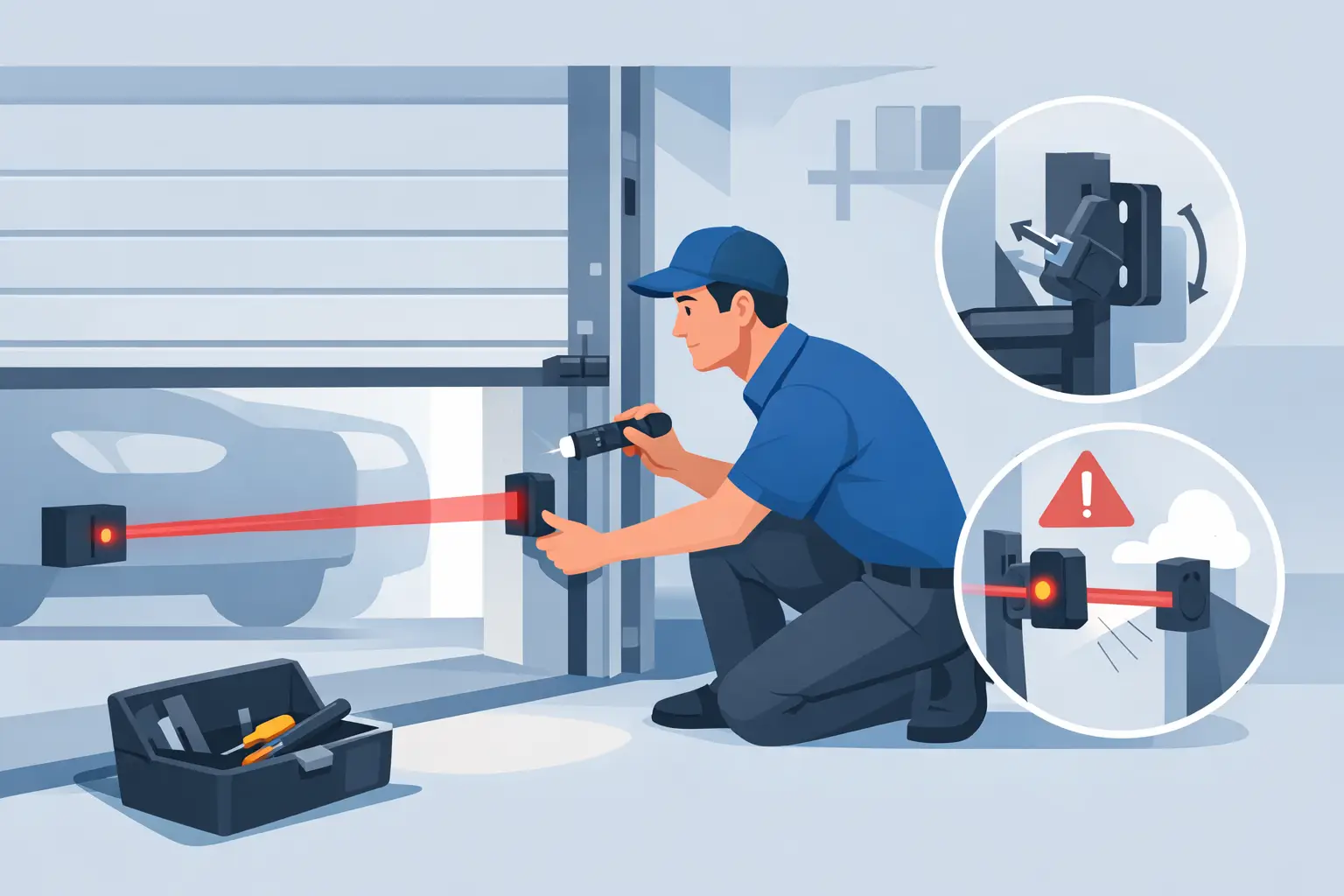
A garage door that closes partway, reverses for no clear reason, or only works when you hold the wall button is often pointing to one place: the safety sensors near the bottom of the tracks. Knowing how to inspect garage sensors can help you rule out a simple blockage before the problem turns into a stuck door, missed appointment, or inaccessible garage.
These small photo-eye sensors are a required safety feature on modern automatic garage doors. One sensor sends an invisible beam across the opening, and the other receives it. If the beam is blocked or the sensors cannot communicate, the opener should not close the door normally. That is a good thing for safety, but it can be frustrating when dirt, misalignment, damaged wiring, or a loose bracket causes a false reading.
Start With Safety, Not a Workaround
Before inspecting anything, keep people, pets, vehicles, and stored items clear of the garage door opening. Do not disconnect, bypass, tape over, or intentionally defeat the sensor system. Those sensors are there to prevent the door from closing on something in its path.
If the door is open and will not close, use the wall control only as directed by the opener manufacturer. On many systems, holding the wall button may allow the door to close while you keep it in sight. Stay clear of the moving door and release the button if anything looks wrong. If the door is crooked, off its track, making grinding noises, or has a broken spring, stop there and call for service. Sensor inspection will not fix a mechanical door problem.
How to Inspect Garage Sensors Step by Step
The sensors sit on opposite sides of the garage opening, usually about 4 to 6 inches above the floor. They are mounted near the vertical tracks and point directly at each other. A quick inspection is usually enough to identify obvious issues.
Check the area between the sensors
Start at floor level and look straight across the door opening. Remove anything that could interrupt the invisible beam, including boxes, tools, bikes, trash cans, snow buildup, leaves, or a vehicle parked too close to the opening. Even a small item in the sensor path can keep the door from closing.
In Cheyenne and surrounding areas, windblown debris and winter slush are common troublemakers. Check the floor for packed snow, mud, or ice around the sensor brackets. The goal is not just to clear the beam but to make sure moisture and debris are not pushing a sensor out of position.
Clean both sensor lenses
Each sensor has a small plastic lens. Dust, cobwebs, road grit, and moisture can interfere with the beam, especially in a garage that is frequently opened during windy weather. Use a clean, soft microfiber cloth to gently wipe each lens.
Do not scrape the lens with a screwdriver, use abrasive cleaners, or spray water directly into the sensor. A damp cloth is enough if there is stubborn dirt. Once both lenses are clean, try the garage door again. A basic cleaning solves more sensor calls than many homeowners expect.
Look at the indicator lights
Most garage door sensors have small LED indicator lights. The exact color and behavior vary by opener brand, but the basic message is usually the same: a steady light generally means the sensor has power and is properly aligned, while a blinking, dim, or unlit light suggests a problem.
Check both sides. If one light is off, first make sure the sensor has not been bumped, the lens is clean, and its wire is still connected. If one light is blinking, the sensors may be out of alignment or something may still be blocking the beam.
Do not rely on color alone. Some brands use green, amber, red, or yellow lights differently. Your opener manual can explain the specific indicator pattern, but a technician can diagnose it quickly if the lights do not make sense or the door continues to reverse.
Check sensor alignment
Sensors must face each other closely enough for the beam to connect. A bracket can shift after someone bumps it with a car bumper, lawn equipment, storage bin, or snow shovel. Vibration from regular door use can also gradually loosen a bracket.
Stand near one sensor and look across to the other. They should be at roughly the same height and pointed directly at each other. If one is visibly tilted, gently adjust the bracket until the indicator light becomes steady. Avoid forcing the bracket or overtightening screws. Old plastic brackets and thin mounting hardware can crack or bend.
It helps to make small adjustments, then wait a moment for the light to respond. If the sensor only works when held in a certain position, the bracket may be loose or damaged and should be repaired rather than repeatedly repositioned.
Inspect the wiring without pulling on it
Follow the low-voltage wires from each sensor as far as you can safely see. Look for loose connections, pinched wire, cuts, missing insulation, corrosion, or staples driven too tightly into the wire. Rodents can also damage exposed sensor wire, particularly in garages with storage or access to unfinished areas.
Do not tug on the wires or attempt electrical repairs unless you are comfortable working with low-voltage garage door wiring. A wire that looks intact can still be broken inside, and a wiring issue may be difficult to isolate without testing equipment. If the sensor lights go on and off when the wire is moved, leave the system alone and schedule a repair.
Test the Safety Reversal System After Inspection
Once the sensors are clean, aligned, and clear, test the door from a safe position. Open the garage door fully, then press the remote or wall control to close it. While the door is closing, pass an object such as a broom handle through the sensor path. Do not use your hand, foot, body, child, or pet for this test.
The door should stop and reverse immediately when the beam is interrupted. If it keeps moving down, does not reverse, or behaves inconsistently, stop using the automatic opener until the system is inspected by a professional.
This test checks the photo-eye system, but it is not the same as the opener's force-reversal test. Most openers also need to reverse when the closing door contacts a solid object on the floor. That setting involves the door's travel and force adjustments. Because an improperly adjusted door can cause damage or injury, it is usually best handled during a professional garage door tune-up.
When the Sensors Are Not the Real Problem
Sensor trouble and garage door trouble can look similar. A door may reverse because the photo eyes are blocked, but it can also reverse because the tracks are bent, rollers are binding, the door is too heavy, the opener force is set incorrectly, or a spring is failing.
If the door closes normally with the wall button held down but not with a remote, sensors are a likely suspect. If the door struggles to open, shakes, hangs unevenly, or makes loud popping or grinding sounds, the problem may be mechanical instead. Never adjust torsion springs, cables, or bottom brackets yourself. Those parts carry significant tension and require the right tools and training.
For commercial overhead doors, the same principle applies, but the stakes are often higher. A failed safety system can interrupt deliveries, employee access, and building security. Commercial doors may also have additional safety devices that need professional testing.
Call for Service When a Simple Check Does Not Fix It
Call a garage door technician if the sensor lights remain off or blink after cleaning and alignment, if wiring is damaged, if the brackets will not stay in place, or if the door reverses with a clear sensor path. Same-day service is especially worthwhile when the door is stuck open, cannot secure the property, or is preventing a business from operating normally.
Mike's Garage Door LLC provides practical diagnosis for homeowners, property managers, and commercial operators throughout Cheyenne and nearby communities. A technician can determine whether the issue is a sensor, wiring fault, opener problem, or a mechanical condition that needs immediate attention.
A clean lens and a properly aimed sensor can restore normal operation in minutes. If the fix is not that simple, do not keep forcing the door closed. A quick professional inspection is the safer way to protect your door, your property, and everyone using the garage.