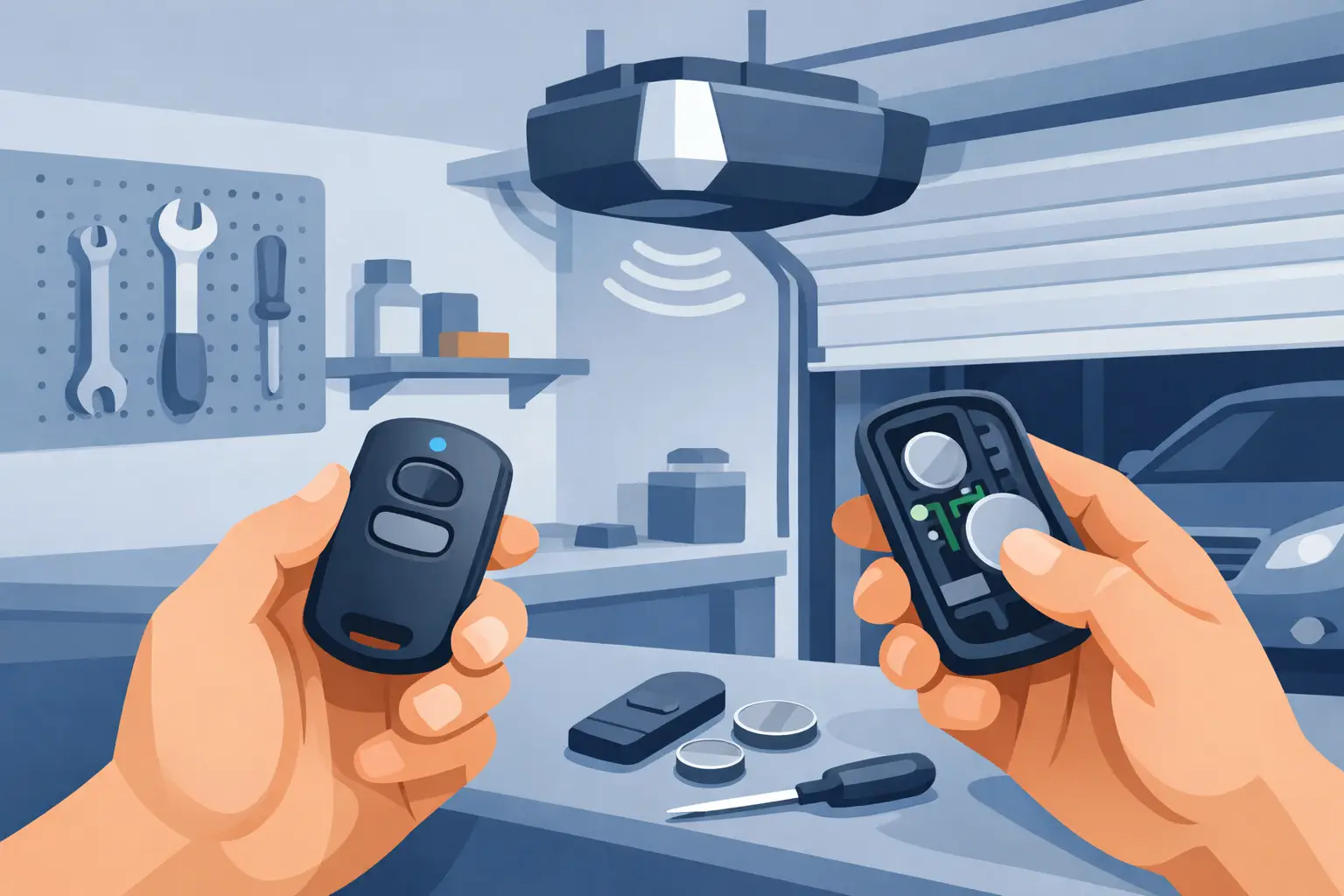
A missing garage remote is more than an inconvenience when you are headed to work, picking up the kids, or trying to secure a commercial building after hours. Knowing how to replace garage opener remote controls starts with one key detail: the replacement must be compatible with the opener, not just the garage door. The good news is that most homeowners can identify and program the right remote in a few minutes. When the opener will not respond or the door moves unpredictably, the problem may be bigger than the remote.
Start by Identifying Your Garage Door Opener
Before buying anything, look at the motor unit mounted on the ceiling of the garage. Find the manufacturer name, model number, and approximate installation date. The label is usually on the side, back, or underside of the opener housing. Common brands include Chamberlain, LiftMaster, Genie, Craftsman, Linear, Marantec, and Overhead Door.
The model number matters because openers use different radio frequencies, security protocols, and programming methods. A remote that looks right may still fail to communicate with your unit. Older openers can use fixed codes set with small switches, while newer models typically use rolling-code technology that changes the access code after each use.
If the label is faded or missing, check the owner’s manual, the paperwork from a prior installation, or the back of an existing working remote. A photo of the opener label and old remote can also help a garage door technician identify the correct replacement without guesswork.
Choose the Right Replacement Remote
The best replacement is usually an original manufacturer remote made for your opener model. It is the most reliable option and generally offers the simplest programming process. A compatible aftermarket remote can also work well, especially for common brands and newer models.
Universal remotes are useful when one household has multiple garage doors with different opener brands. They can also be a practical choice for property managers who want fewer remotes to keep track of. The trade-off is that universal remotes may require more setup, may not support every older opener, and can be less straightforward when troubleshooting.
Avoid choosing a remote based only on its appearance or the number of buttons. Confirm that it supports your opener’s brand, model, frequency, and security type. If you have a very old opener with dip switches, a matching remote needs the same switch configuration. If your opener was manufactured before modern safety and security standards, replacing the entire operator may be a better long-term decision.
Consider a Keypad or Smart Controller Too
A replacement remote is not always the only answer. A wireless exterior keypad gives family members, tenants, or employees access without handing out multiple remotes. A smart garage controller can provide app-based access, activity notifications, and the ability to check whether the door is open.
These options are convenient, but they do not fix a worn-out opener, damaged safety sensors, or a door that is too heavy for the motor to lift. The opener is only one part of the system. Springs, rollers, tracks, cables, and the door itself all affect how reliably it operates.
How to Replace Garage Opener Remote Controls
Once you have a compatible remote, programming usually takes less than a minute. Start with the garage door closed and make sure the opener has power. Keep the ladder stable if you need to reach the motor unit, and do not stand on a vehicle or an unstable surface.
Most modern openers have a small Learn, Program, Smart, or Set button on the motor unit. It may be near the antenna wire, under a light cover, or behind a control panel. Press and release that button. An indicator light will usually turn on or blink, showing that the opener is ready to accept a new remote.
Within about 30 seconds, press and hold the button on the new remote that you want to use. The opener light may flash, click, or cycle to confirm programming. Test the remote from inside the garage first, then from the driveway at a normal operating distance.
The exact timing and button sequence vary by manufacturer. If the remote does not pair on the first try, wait a few seconds and repeat the process using the instructions for that model. Do not hold the Learn button down for an extended period unless the manufacturer specifically directs you to do so. On many units, holding it too long clears all programmed remotes and keypads.
For Older Openers With Dip Switches
Older fixed-code openers use a row of tiny switches inside the remote and on the opener receiver. Open the battery compartment of the old remote, if available, and copy the switch positions exactly to the replacement. Each switch must be in the same up, down, or middle position.
If you cannot find an old remote, you may need to access the receiver or opener controls to read the switch settings. This is where a professional can save time, particularly if the opener is mounted high, the unit is obsolete, or the receiver is difficult to reach.
Test the Door, Not Just the Remote
A remote that activates the opener does not automatically mean the system is operating safely. After programming, run the door through a full open-and-close cycle while watching and listening. The door should move smoothly, stay aligned in the tracks, and close without jerking, grinding, or reversing for no clear reason.
Test the photo-eye safety sensors near the bottom of the tracks. With the door open, start it closing and pass an object through the sensor beam. The door should reverse immediately. Also test the auto-reverse system by placing a solid piece of wood, such as a 2-by-4 laid flat, beneath the door. It should reverse after touching the object.
If the door slams, binds, hangs unevenly, or will not reverse properly, stop using it until the issue is checked. Never adjust garage door springs or cables yourself. Those components are under extreme tension and can cause serious injury when handled incorrectly.
What If the New Remote Still Does Not Work?
First, install a fresh battery and confirm the battery contacts are clean and secure. Then verify that the wall button operates the door. If the wall button works but the remote does not, the problem may be programming, remote compatibility, antenna damage, or radio interference.
LED light bulbs are a common source of interference with garage remote signals. If the remote works only when you are close to the garage, try temporarily turning off nearby LED lights or replacing bulbs in the opener with garage-door-compatible LEDs. Metal shelving, wireless equipment, and certain electronic devices can also reduce signal range.
If neither the wall button nor the replacement remote works, check whether the opener has power. Look for a tripped GFCI outlet, a disconnected plug, or a breaker issue. An opener that hums but does not move may have a stripped gear, failed capacitor, travel-limit problem, or a door that is too heavy because of a broken spring.
A door that opens a few inches and stops is not a remote problem. Neither is a door that has come off its tracks, has a loose cable, or feels unusually heavy when released from the opener. Forcing the opener in these situations can turn a repairable problem into a larger repair.
When It Makes Sense to Call a Local Technician
Replacing a remote is a reasonable do-it-yourself task when the door is operating normally and you have confirmed the replacement is compatible. Call for service when the opener will not program, the remote range is poor after basic checks, or the door itself shows signs of mechanical trouble.
For Cheyenne-area homeowners, property managers, and business operators, Mike's Garage Door LLC can diagnose the opener and the full door system, not just sell a remote. A technician can determine whether a new remote, receiver, repair, or complete opener replacement is the sensible fix, with clear pricing before work begins.
Keep one programmed remote in a secure place, replace weak batteries before winter, and test the safety reversal system regularly. A working remote gets you through the door, but a properly operating garage door system is what keeps your home or property secure.