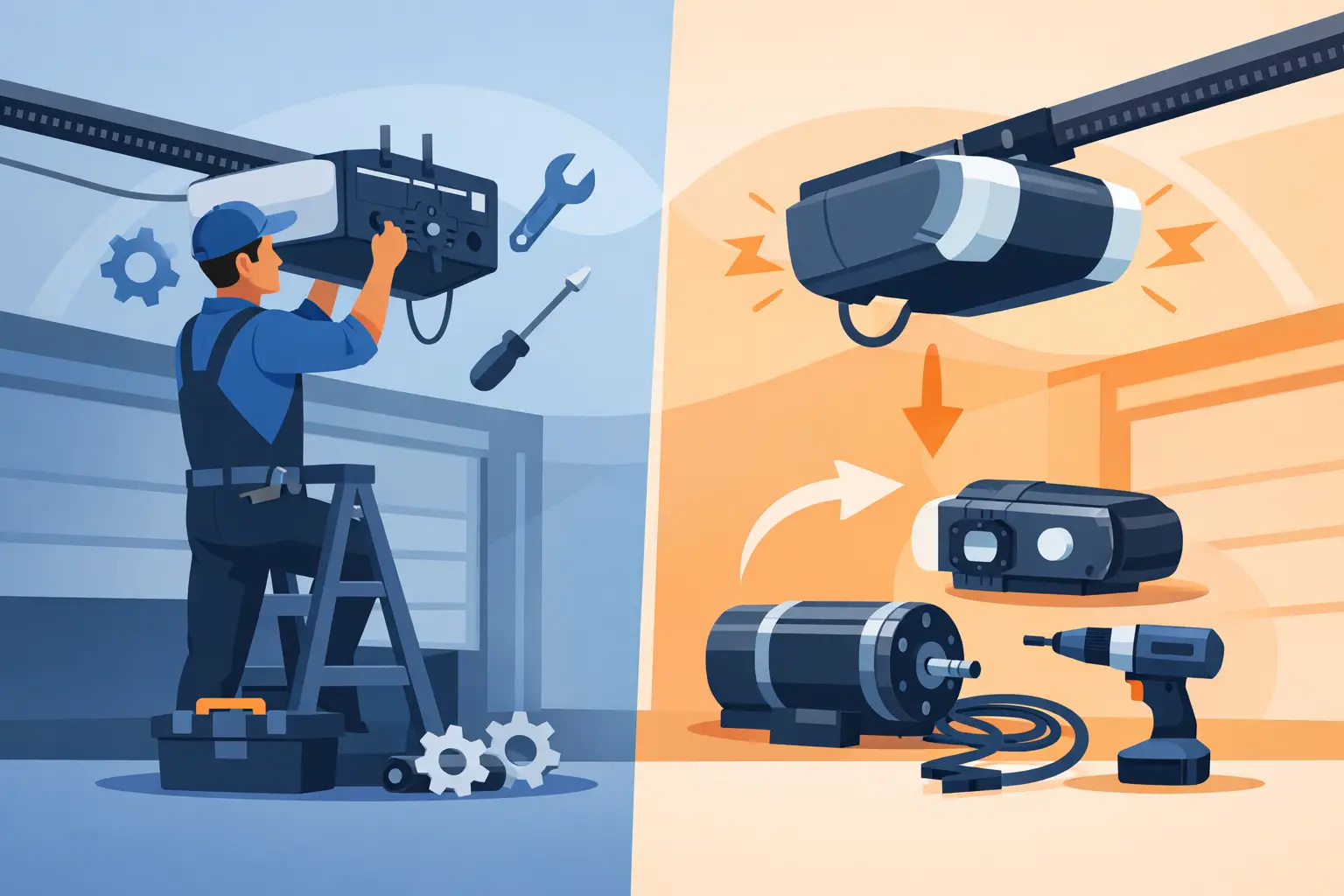
A garage door that will not open at 6:30 a.m. can make a small mechanical problem feel like a major emergency. When the wall button clicks, the lights flash, or the motor hums without moving the door, homeowners often ask about repairing opener vs replacing motor. The right answer depends on what actually failed - and on whether the opener is the problem at all.
A garage door opener and its motor work as part of a larger system. A worn gear, faulty safety sensor, failing capacitor, damaged belt, weak spring, or door that is binding in the tracks can all look like a motor failure. Replacing a motor without finding the underlying issue may cost more and still leave you with a door that does not operate safely.
Start With the Door, Not the Motor
Before deciding whether to repair or replace an opener, a technician should check how the garage door moves by hand with the opener disconnected. A balanced door should lift smoothly and stay near the halfway point without dropping hard or shooting upward. If it feels unusually heavy, a broken spring may be the real cause of the trouble.
This matters because the opener is designed to guide the door, not carry its full weight. When a spring breaks or loses tension, the opener has to work far beyond its intended load. The motor may hum, strain, or stop partway through a cycle. In some cases, the opener is still serviceable once the spring issue is corrected. Continuing to run it against a heavy door, however, can damage gears, the drive system, or the motor itself.
A door that is off track, has bent rollers, or catches against a damaged section can create the same kind of strain. That is why a complete diagnosis is worth more than guessing based on one symptom.
When Repairing an Opener Makes Sense
Opener repair is usually the practical choice when the unit is relatively modern, the door is in good mechanical condition, and the failed part is available. Many common opener problems involve components that can be repaired without replacing the whole system.
For example, an opener may need a new drive gear after years of normal use. A stripped gear often causes the motor to run while the chain, belt, or screw drive does not move the door. A worn sprocket, loose chain, damaged trolley, failed logic board, or bad travel-limit setting may also be repairable.
Electrical issues can sometimes be corrected as well. If the remote works inconsistently, the issue could be a weak battery, antenna interference, a faulty wall control, or a receiver problem rather than a failed motor. If the opener reverses immediately after closing, dirty or misaligned photo-eye sensors are a common cause. Those are straightforward repairs when addressed early.
Repairing the opener can be the better value when:
- The opener is under about 10 years old and has otherwise operated reliably.
- The motor runs normally but a gear, trolley, belt, chain, sensor, or control component has failed.
- Replacement parts are available and reasonably priced.
- The door is balanced and moving freely by hand.
- The opener already has safety features and power capacity that fit the door.
Age is not the only factor. A quality opener that is eight years old with one worn gear may be a better repair candidate than a cheaper 15-year-old unit with repeated electrical problems.
Repairing Opener vs Replacing Motor: Know the Difference
People often use “motor” to describe the entire opener mounted above the garage door. In practice, the motor is only one part of the assembly. On many residential units, replacing the motor alone is not the usual repair. The labor and part cost can make a complete opener replacement more sensible, especially if the unit is older or other components are also worn.
A true motor problem may show up as a hot or burning smell, a motor that only hums, repeated tripping of the circuit breaker, or a unit that runs intermittently even after the door, sensors, and drive components have been checked. Still, those symptoms require careful testing. A failed start capacitor, damaged wiring, or a worn gear can resemble a dead motor.
For commercial overhead doors, the decision can be more specialized. Commercial operators are often heavier-duty systems with serviceable components, and motor repair or replacement can make sense when the operator body, controls, and drive system remain in good condition. The door’s cycle count, size, weight, and daily use all affect the recommendation.
The practical question is not simply, “Can the motor be replaced?” It is, “Will this repair restore dependable service at a fair cost, or is the entire operator near the end of its useful life?”
Signs Replacement Is the Better Long-Term Choice
A new opener is often the smarter move when repairs begin stacking up. If the logic board has failed, the motor is weak, the drive system is worn, and parts are becoming difficult to find, putting more money into the old unit may only delay the next breakdown.
Replacement also deserves serious consideration if the opener lacks modern safety and convenience features. Current openers typically include photo-eye safety reversal, better rolling-code security, battery backup options, quieter belt-drive operation, and smart controls that allow you to check or operate the door from a phone. Not every household needs every feature, but a replacement can solve both reliability and convenience problems at once.
For homeowners with an attached garage, noise can be a deciding factor. A chain-drive opener can be dependable, but it may be loud enough to disturb rooms above or beside the garage. A properly selected belt-drive model is often quieter. For a heavy insulated door, an opener with the right lifting capacity and drive type is more important than choosing based on price alone.
Replacement is generally the better choice when the opener is older, has recurring failures, does not have dependable safety sensors, or cannot get parts without excessive cost. It is also a good option after a severe power surge or water damage, when electrical reliability becomes uncertain.
Cost Depends on the Actual Failure
There is no honest flat answer for repair versus replacement without inspecting the system. A sensor adjustment or remote programming issue may be minor. Replacing a gear, circuit board, or drive component can cost more, depending on the opener model and availability of parts. A full replacement varies based on horsepower, drive type, battery backup, smart features, and installation requirements.
The lowest immediate price is not always the lowest overall cost. A repair can be the right decision if it gives you several more dependable years of service. But if an older opener needs a significant repair today and another major component soon after, replacement may protect your budget better.
A clear estimate should explain what failed, what repair involves, and why replacement is or is not recommended. You should not be pressured into a new opener when a sound repair will do the job. You also should not be sold a temporary repair when the unit is no longer reliable enough for daily use.
Safety Comes Before a Quick Fix
Garage door systems store a lot of force. Springs, cables, drums, and openers under load can cause serious injury or property damage when handled incorrectly. Homeowners can safely check obvious items such as remote batteries, a tripped breaker, objects blocking the photo eyes, and whether the manual lock is engaged. Beyond that, it is wise to leave diagnosis and repairs to a trained garage door technician.
Do not disconnect an opener and force a door open if it feels heavy or crooked. Do not adjust torsion springs, cables, or bottom brackets. Those are not routine DIY parts. If the door is stuck open, off track, or will not secure, it should be treated as a priority service issue.
Get a Straight Answer Before You Spend
For Cheyenne homeowners, property managers, and business operators, downtime is usually the biggest concern. A garage that will not close affects security. A door that will not open can trap vehicles, delay deliveries, or interrupt a workday. Mike's Garage Door LLC can inspect the door, springs, tracks, safety system, and opener together, then provide a clear recommendation based on the condition of the complete system.
The best outcome is not automatically a repaired opener or a new motor. It is a garage door that runs safely, reliably, and without putting extra stress on the parts that have to work every day.